
Autotask - Connect to Inscora
Once you have your Autotask API credentials in hand, this is the Inscora-side flow to plug them in. If you don't have credentials yet, start with Get Autotask API Credentials - this guide picks up where that one leaves off.
You'll need two values from Autotask:
- The API User (username) - your Autotask Username (Key).
- The API Secret - your Autotask Password (Secret).
Connecting Autotask in Inscora
- Open the Integrations page. In the left sidebar under Organization, click Integrations. The page lists every integration grouped by category.
- Find Autotask PSA in the Available list under Professional Services Automation. Click Connect on the right of the card.
- Enter your credentials in the connection dialog:
Field | What to enter |
|---|---|
API User (username) | Your Autotask Username (Key) from Get Autotask API Credentials. |
API Secret | Your Autotask Password (Secret). Use the eye icon to reveal what you typed if you need to double-check. After saving, Inscora only ever displays the last three characters of the secret - this is standard practice for API keys and lets you sanity-check which secret is in use without exposing the full value. |
The Autotask API URL doesn't appear here - Inscora detects it automatically from your credentials.
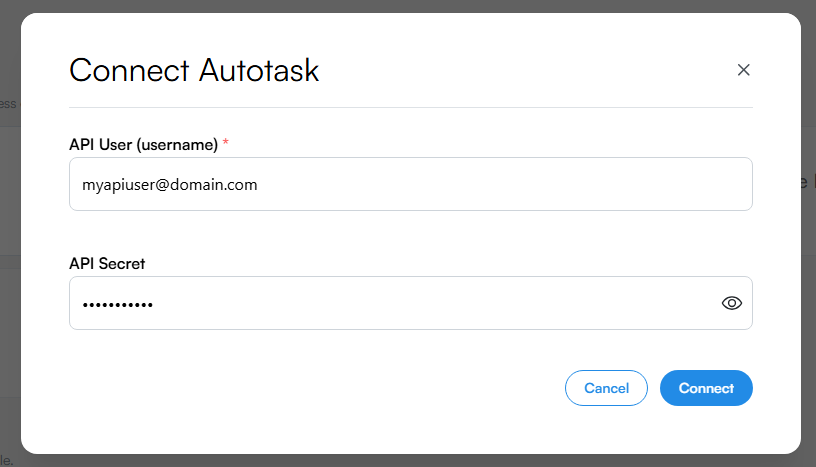
The Connect Autotask dialog. Two fields: API User and API Secret.
- Click Connect. Inscora verifies the credentials against Autotask. On success, the dialog closes and Autotask PSA moves into the Configured Integrations section at the top of the page with a green ACTIVE badge.
- Test the connection. Click the Test button on the configured Autotask card to confirm the integration is healthy. The Last verified timestamp updates on success.
ℹ️ What happens once Autotask is connected? With the integration active, the Import Clients panel on the Clients page gains an Autotask tab. From there you can pull your existing Autotask client list directly into Inscora in bulk.
Editing or Rotating Credentials
To change the API user or rotate the secret, click the settings gear on the Autotask card in Configured Integrations. The Edit Autotask connection dialog opens.
The dialog shows:
- The current ACTIVE status and Last verified timestamp.
- The auto-detected Autotask API URL (read-only, e.g.,
https://webservices2.autotask.net/ATServicesRest- the exact webservices region depends on your Autotask account).
- The API User (username) field - edit to change which API user Inscora uses.
- The API Secret field - leave blank to keep the existing secret, or enter a new value to rotate.
- A red Disconnect button on the left, Cancel and Save changes on the right.
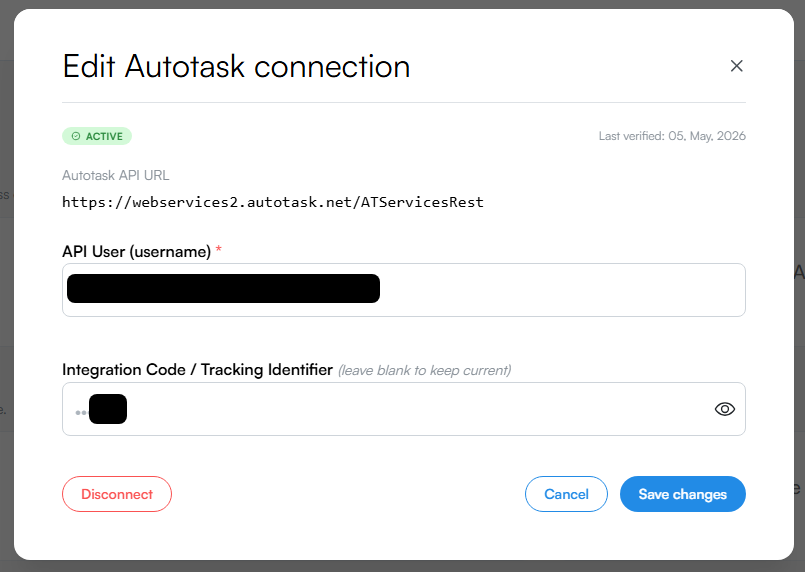
Editing an existing Autotask connection. Leave the secret field blank to keep the current value.
⚠️ Rotating the secret. Generate the new Password (Secret) in Autotask first (open the API User, click Generate Secret, Save & Close), then come back here, paste it into API Secret, and click Save changes. Inscora re-verifies the connection on save - if the new secret fails, the integration stays on the previous value.
Disconnecting
Click Disconnect in the edit dialog to remove the integration. Inscora stops calling the Autotask API and the integration moves back into the Available list. Existing clients you imported from Autotask remain in Inscora; only the link is severed.
Troubleshooting
Symptom | What to check |
|---|---|
Connection fails on first save | Confirm the API User is Active in Autotask and that you saved the API User there before clicking Connect in Inscora. Re-check that the secret was copied without leading or trailing whitespace; use the eye icon to verify what you pasted. |
Test button reports an error after working previously | The Password (Secret) may have been rotated or revoked in Autotask. Open the edit dialog and enter a fresh secret, or follow Lost the Secret? on the credentials page. |
Permissions error during import | Verify the API user was created with the API User (system) (API-only) security level — that's the level Inscora expects, and trimmed clones cause permission errors that only surface mid-import. See the Security Level callout in the credentials guide. |